
When people think of scientific research, they often picture laboratories and test tubes. At our experimental field in Venlo, however, research looks quite different. Between rows of hosta, astilbe, and other perennial crops, drones take to the sky while state-of-the-art sensors examine plants leaf by leaf on the ground. Together, these technologies provide a comprehensive understanding of how plants respond to drought stress.
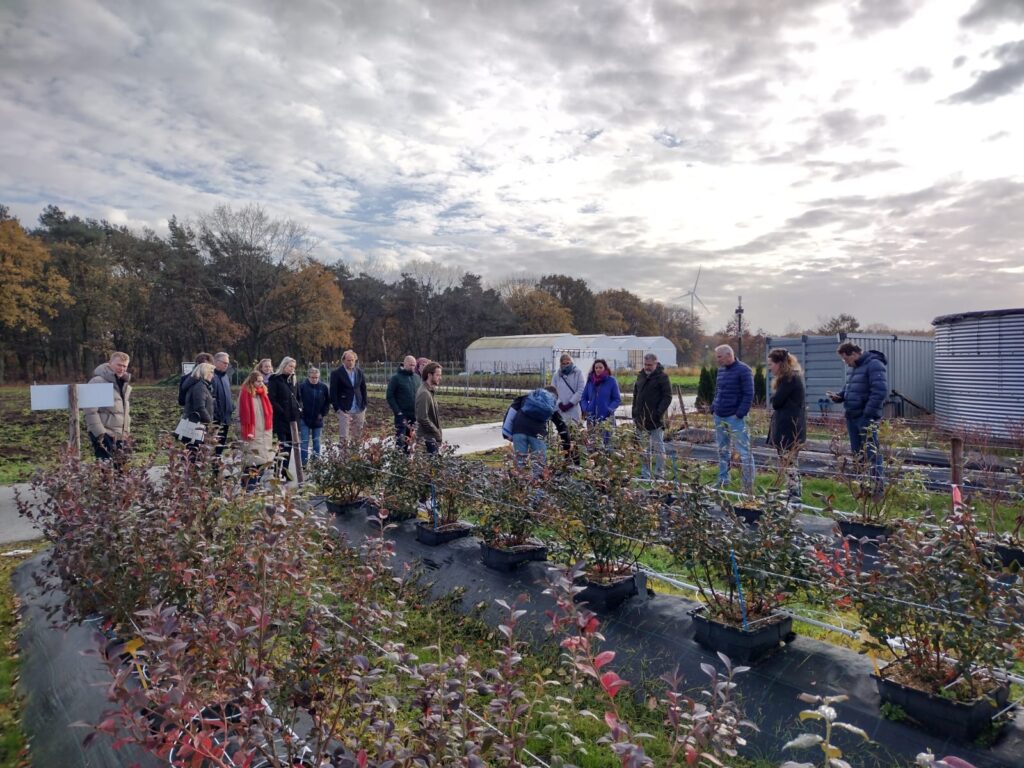
On a typical measurement day, several teams work side by side. While Moritz Prüm from Rhine-Waal University of Applied Sciences captures aerial data of the experimental plots, Dr. Tony de Oliveira investigates the very same plants using fluorescence and hyperspectral sensors at canopy and leaf level.
A Bird’s-Eye View
The drones provide much more than impressive aerial imagery. They can survey entire experimental fields within a short time, making it possible to identify differences between irrigation treatments across the whole trial.
“We use multispectral and thermal sensors because these systems are already available and affordable for farmers and other stakeholders.”
– Moritz Prüm
The multispectral images provide valuable information about plant health and water stress. At the same time, RGB imagery is used to generate detailed three-dimensional models of the plants, allowing researchers to estimate biomass and calculate additional vegetation parameters.
More recently, the sensor platform has been expanded with a thermal camera. By measuring temperature differences within the plant canopy, it provides another valuable indicator of drought stress.
Looking Inside the Plant
While the drones observe the crop from above, Tony’s measurements focus on the physiological processes taking place inside the leaves.
Using an imaging fluorometer, he measures chlorophyll fluorescence. In simple terms, the system detects the portion of absorbed light that the plant does not use for photosynthesis.
“This device captures the light that the plant is not using for photosynthesis. Based on this signal, you can detect if the plant is stressed or not stressed.”
– Dr. Tony de Oliveira
These measurements reveal the efficiency of photosynthesis and therefore provide valuable information about the physiological status of the plant—often before visible symptoms of drought stress appear.
To complement these measurements, Tony also performs leaf-level gas exchange measurements and additional fluorescence analyses. Together, these methods provide a detailed picture of how plants respond to water limitation.
Why Combine Different Sensors?
Each measurement technique offers a different perspective on plant health.
Drone-based observations rapidly assess entire fields and capture spatial variability, while fluorescence measurements provide insight into the physiological processes occurring inside individual leaves.
“Drones can tell you whether a plant is doing well. But with the fluorescence sensor you can see how the inside of the leaf responds to drought.”
– Dr. Tony de Oliveira
Research Under Real-World Conditions
By combining these complementary datasets, researchers gain a much more complete understanding of plant responses to drought.
Field research also comes with unique challenges. Unlike laboratory experiments, environmental conditions cannot be controlled.
Wind, in particular, can make high-resolution measurements more difficult.
“If you want to look at leaf level, you need very stable conditions. Wind moves the leaves, which reduces the accuracy of the measurements.”
– Dr. Tony de Oliveira
Despite these limitations, imaging technologies offer a major advantage: they can collect large amounts of data far more efficiently than traditional leaf-by-leaf measurements.
Towards Smarter Irrigation Decisions
This is exactly where the IRRISTAUD project comes in. Rather than relying on a single sensing technology, the project combines multiple complementary approaches to better understand plant responses to drought.
Drone imagery provides a field-scale overview, while fluorescence measurements reveal the physiological processes occurring inside the plant. Together, these datasets form the foundation for new approaches that can detect drought stress at an early stage and ultimately support more precise and sustainable irrigation management.
Because only by understanding how plants respond to drought—from the individual leaf to the entire canopy—can we develop irrigation strategies that are both more efficient and more sustainable.